
As of March 26, the ACPS school board has decided to revisit the county grading policy and related guidelines in order to determine whether they need to be revised for upcoming school years. The decision comes in the midst of a nationwide debate about “equitable” grading policies—a debate which is no less prevalent within Albemarle county.
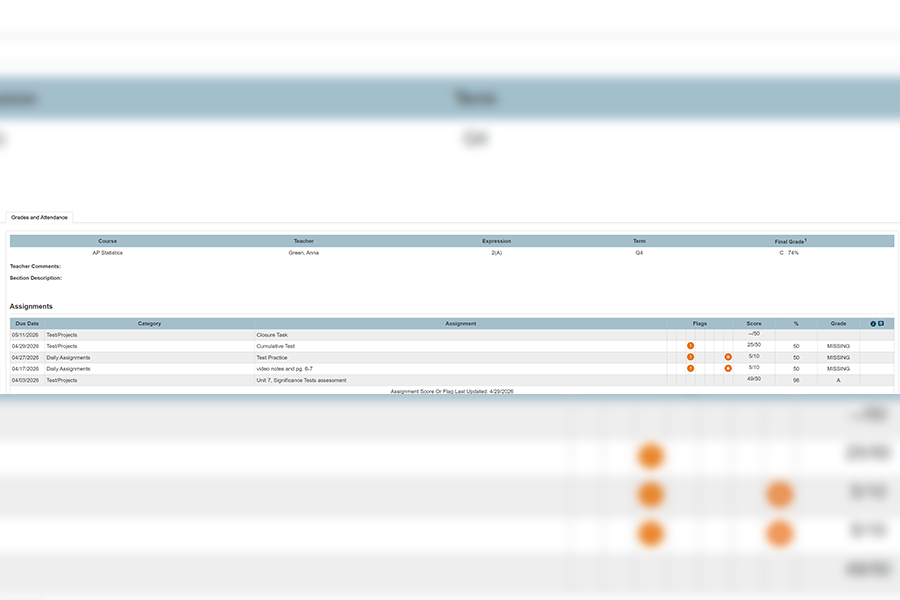
The grading policy itself is a broad but short document in which ACPS commits itself to a “balanced and equitable assessment system.” It provides the basis for the associated grading guidelines, also up for revision and formed in 2020 by a group of “Grading Champions” composed of teachers, administrators, and other community members. The guidelines include a minimum grade of 50% for all assignments, a push to eliminate graded homework, and a two-week revision policy, all provisions currently facing criticism.
“Every school system needs to have a policy in place to make sure grades are rigorous and accurate and fair, meaning equitable and consistent and transparent,” Bob Beard, Samuel Miller school board representative, said. “That is what I believe every member of the school board wants our grading policy to be.”
Prior to March 26, the ACPS school board planned to vote on a renewal of the policy and guidelines at that school board meeting as part of standard procedure of reviewing or renewing policies on a five-year cycle. However, due to criticism from teachers and parents that the guidelines are too lenient toward students, they have chosen to revisit them entirely.
“In some cases, policies are fine the way they are written, and no changes are made,” said assistant Superintendent Chandra Hayes. “In this case with the grading policy, there were people who had concerns—maybe some with the policy, but others with the practice around retakes and the minimum of receiving a 50,” she said.
The ACPS Family Council, an advisory group to the school board, criticized the planned vote, saying the school board wanted to “quietly continue as-is without local controversy” in a recent blog post.
Similarly, English teacher Emma Almario said that the guidelines “misrepresent reality and encourage students to think about the world in a different way than it is.” She expressed concerns especially with the minimum grade of 50% and a lack of a penalty for late work. “Students should not be enshrining poor habits,” she said, calling such practices a “failure of education.”
As Almario stated, community members point to the minimum grade of 50% and no penalties for late work as shortcomings of the guidelines. Nevertheless, teachers have touted some elements: Almario conceded that the revision policy facilitates better understanding of the material, and science teacher Malinda Smith highlighted a ban on extra credit work as a positive point.
In general however, Almario’s and the Family Council’s views reflect those held by a majority of teachers, at least in ACPS. Smith sent out a form to over 300 middle and high school teachers asking if they think the policy should be adopted unchanged for the next five years. Of the 304 teachers surveyed, only three responded yes.
“My survey was not intended to try to figure out ‘what does everybody think is wrong with [the policy],’” Smith said. “It was just ‘you think we should read off this for five years without even asking anybody what they think?’ I think you should ask people what they think.”
The overwhelming negative response from teachers and other community members about the policy has prompted plans for the formation of a grading committee of students, teachers, families, administrators, and division staff to review the guidelines for future years. To give the decision-making process room to breathe, there is no set timeline, and the school board instead will allow the committee to build their timeline as needed.
“[We] don’t want to rush it… we want to do what’s best for the school system,” Beard said.
At the same time, Almario is wary of expecting substantial change. In her experience, the school board has “placate[d] frustration, and then nothing ever changes,” she said, warning against “allowing teachers to express frustration” without implementing real changes.
More broadly, public opinion on “equitable” grading systems such as Albemarle County’s has seen a recent shift. While such policies surged in popularity after the pandemic with the goal of leveling the playing field and encouraging students from all backgrounds to succeed, they are now facing opposition across the country.
A study by the Thomas B. Fordham Institute found that 81% of teachers believe that a “no zeros” grading practice—known as the minimum 50% practice in ACPS—is harmful to student learning long-term, followed by a lack of penalties for late work and no graded homework.
That said, school districts have only recently begun to move away from “equitable” grading policies, just as ACPS is doing. The only remaining question is how.